
The Braveheart CIO · Field Notes
Can AI help you win the Treasure Hunt of the Palio di Siena?
Ninety executives, nine teams, AI in every pocket.
AI is supposed to level the playing field. Give a room full of executives the same tools, and the same answers should be one prompt away for everyone. Put them in a competition, and you would expect a near tie.
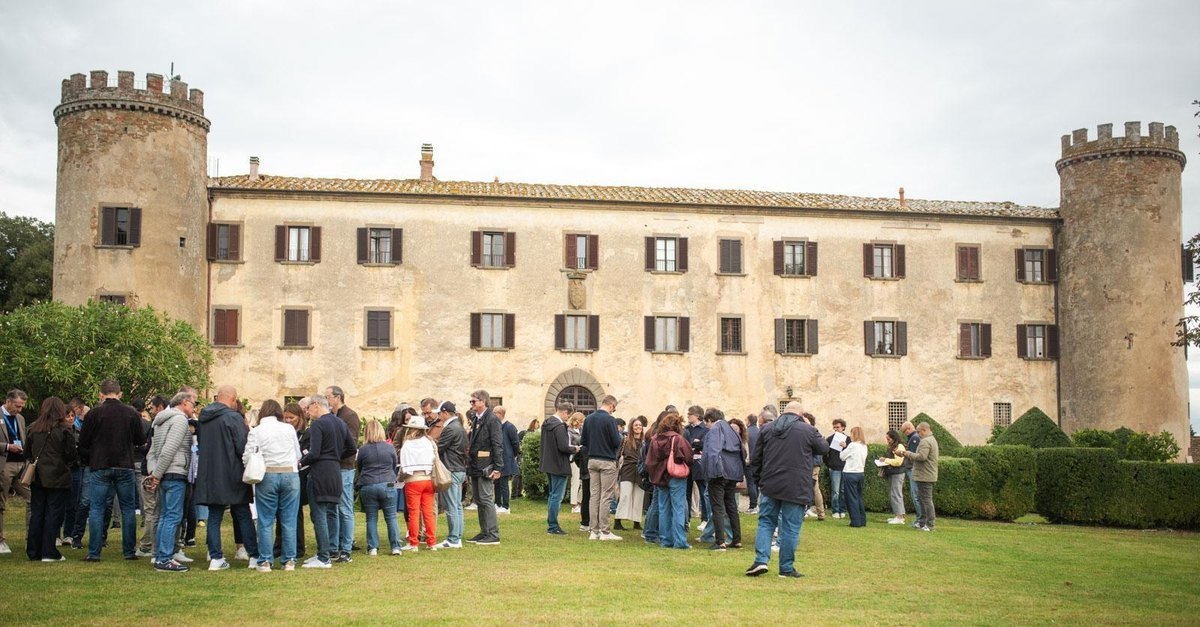
That was my assumption on October 9th, 2026, at the CxO Summit 2026 in Italy, organised by CIONET and sponsored by IBM, Orange and other technology companies, where I presented my book in conversation with Francesco Tondi, Managing Director of CIONET Italy. After the business sessions, all participants were invited to network and play a classic Treasure Hunt at the Castle of Calcione, near Siena, in a breathtaking stretch of Tuscan countryside.
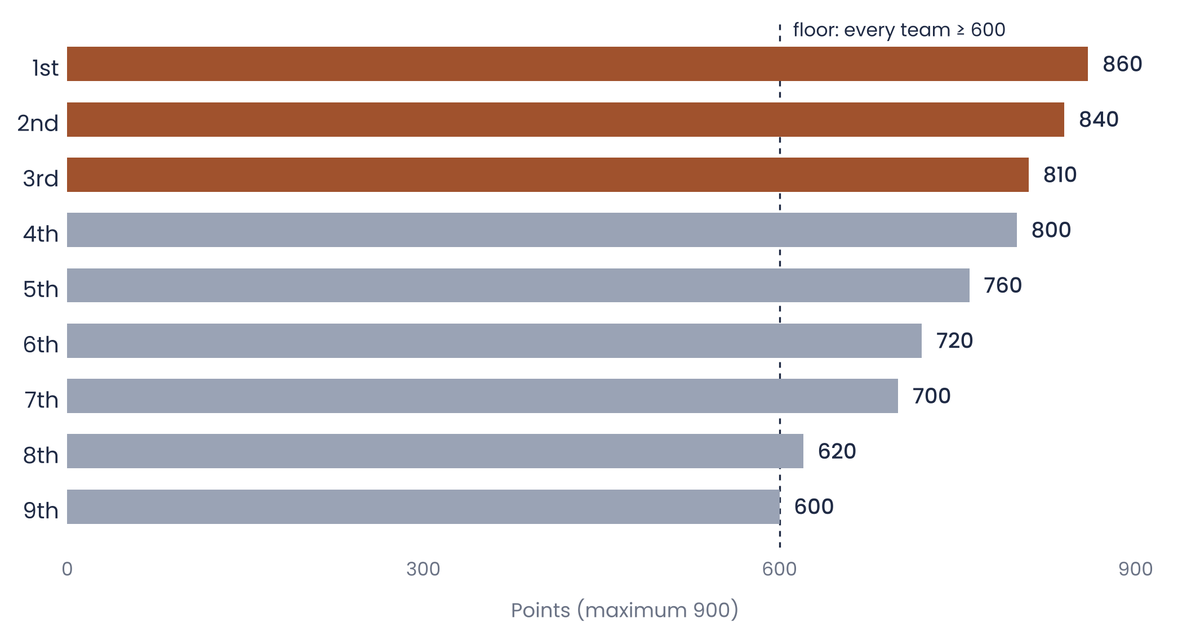
The game context: about 90 participants. 9 teams. 9 play areas. A maximum of 900 points per team.
My first thought was: what’s the point of a treasure hunt when everyone will simply rely on their phones and AI?
Was I right?
A question for you first
Before I tell you the rest of the story: how close do you think the scores were? How much more did the 1st team score than the 9th?
- below 10%
- between 10% and 30%
- above 30%
The answer is at the end of this page. Make up your mind, check the result, then come back and join the conversation.
Now that you’ve seen the end of the movie, let’s reflect on why this happened.
First, some more context. The game was about horses and the history of the Palio di Siena. These were very specific and difficult questions about a niche topic, not general knowledge like football or cuisine.
Everyone had a data connection, via 5G/4G and the castle’s Wi-Fi. Everyone could use their phone. And everyone was familiar with LLMs, which were spread fairly evenly across the participants according to personal preference: Gemini, Claude, ChatGPT, you name it. They were all there.
So why, when everyone had access to the same technology, did we get such different results?
Three observations from the game
1) Organisation. A treasure hunt is dynamic. It’s not sitting in front of a computer taking a test. Activities have to be coordinated across the team, under time pressure, with time as the critical resource. Tasks have to be allocated among team members. Teams have to cover a large area on foot. None of this could be done by AI.
2) Decision making. For many questions, different LLMs gave different answers. That’s normal if you know how GenAI works, yet many people were surprised, and some were genuinely upset. Either way, each team needed a process to resolve disagreement and apply judgement, and sometimes had to commit without a clear answer at all. In the end, the answer had to come from a person, not from AI.
3) Digital literacy. Levels of digital savviness varied widely. Some people wanted to use AI for everything. Others knew a quick Google search was good enough. Others trusted Wikipedia more. Teams had different standards for which tool to use when.
I’m sure there was more that made the difference, and if I lived the experience again, I’d probably spot it. But what I saw is, in my view, enough to formulate the following hypotheses.
Three hypotheses
1) The human factor made the difference. Everyone had AI, so AI was not the discriminator. With the same technology in every hand, how people behaved, and how they used it, produced a 43% gap between first and last place.
2) AI raised the floor. Given how specific the questions were, I believe that without AI the scores would have been lower across the board. That’s still to be proven, but consider this: even the last team scored 600 out of 900 on obscure Palio history.
3) AI will boost human potential, but humans decide how far. The extent of the boost depends mainly on people: how they organise, how they decide, and how wisely they use the tools.
The results don’t prove that human behaviour alone explains the difference. But they suggest an important hypothesis: when access to AI becomes widespread, the way people organise, judge and act may become a more important source of competitive advantage.
The lesson extends well beyond a treasure hunt. As AI becomes widely accessible, competitive advantage will increasingly depend on how organisations redesign work, develop judgement and turn intelligence into action.
What should a CEO do differently on Monday morning?
- Are we redesigning work around AI, or simply giving employees AI tools?
- Do our teams know how to validate AI-generated answers and challenge conflicting outputs?
- Are we measuring the business outcomes AI enables, rather than adoption and usage alone?
I’ll admit the outcome surprised me. I expected AI to make everyone equal. It didn’t.
AI raises everyone’s floor. Humans still decide the ceiling.
The answer
The correct answer is c) above 30%. The 1st team scored 860 points and the 9th scored 600: a gap of 260 points. The winning team scored 43% more than the last.
Benedetto Conversano is a former Global CIO at Diageo, Avon and Jerónimo Martins, a non-executive director, keynote speaker, and author of The Braveheart CIO: Why Every CEO Needs One at the Table.
Field notes from the CxO Summit 2026, organised by CIONET and sponsored by IBM, Orange and others, held near Siena on 9 October 2026. The treasure hunt took place at the Castle of Calcione: 90 participants, 9 teams, 9 play areas, a maximum of 900 points. Scores as recorded by the organisers.